Anomalo vs Ataccama vs Soda: Data Quality Compared
Table of Contents
- Anomalo vs Ataccama vs Soda overview
- Anomalo vs Ataccama vs Soda data quality tools comparison
- How AI data quality and anomaly detection differ
- Data profiling and governance capabilities
- Data quality tool integration and deployment options
- Data quality tools pricing and total cost
- Real-world AI data quality and anomaly detection examples
- How to choose: Anomalo vs Ataccama vs Soda
- A practical 30-day data quality tools comparison plan
- Conclusion
- Anomalo vs Ataccama vs Soda overview
- Anomalo vs Ataccama vs Soda data quality tools comparison
- How AI data quality and anomaly detection differ
- Data profiling and governance capabilities
- Data quality tool integration and deployment options
- Data quality tools pricing and total cost
- Real-world AI data quality and anomaly detection examples
- How to choose: Anomalo vs Ataccama vs Soda
- A practical 30-day data quality tools comparison plan
- Conclusion
Anomalo vs Ataccama vs Soda overview
An on-time table can still be wrong. Customer records may duplicate IDs, a marketing feed may omit a region, or an inventory column may change meaning without being renamed. AI data quality tools use profiling and anomaly detection to catch these problems before they reach reports, applications, and machine-learning models.
Choosing the right operating model is difficult. Anomalo, Ataccama, and Soda overlap but approach data quality differently. This comparison covers:
- Automated anomaly detection and rule-based validation
- Data profiling, governance, and remediation
- Database, pipeline, and notification integrations
- Pricing models and setup costs
TL;DR: Anomalo favors automated discovery, Ataccama offers broad enterprise data management, and Soda combines monitoring with contracts and code-based testing.
Anomalo vs Ataccama vs Soda data quality tools comparison
No product is universally best. The choice depends on whether the team needs automatic monitoring, governed data management, or tests engineers can place directly in pipelines.
| Area | Anomalo | Ataccama ONE | Soda |
|---|---|---|---|
| Strongest fit | Automated monitoring with limited manual configuration | Enterprise quality, cataloging, governance, and remediation | Data contracts, CI/CD testing, and flexible monitoring |
| Main approach | Unsupervised machine learning plus custom rules | Rules, profiling, anomaly detection, catalog context, and cleansing | ML-powered observability plus executable data contracts |
| Typical users | Data analysts, stewards, and platform teams | Data stewards, governance teams, engineers, and business owners | Data engineers, platform teams, analysts, and contract owners |
| Code options | No-code interface, SQL, API, and Python SDK | Visual tools, natural-language rule creation, APIs, and SDKs | No-code Cloud interface plus YAML, CLI, Python, and open-source Core |
| Governance depth | Integrates with external catalogs and lineage tools | Built-in catalog, glossary, lineage, reference data, and stewardship | Ownership, roles, contracts, incidents, and catalog integrations |
| Pricing model | Custom quote, generally table-based | Custom quote with volume-based licensing | Free, usage-based Team, and custom Enterprise plans |
- Choose Anomalo for fast, automated coverage of unknown data changes.
- Choose Ataccama to embed quality in a larger governance, catalog, cleansing, or master data program.
- Choose Soda data quality for machine-readable contracts, pipeline gates, and production monitoring.
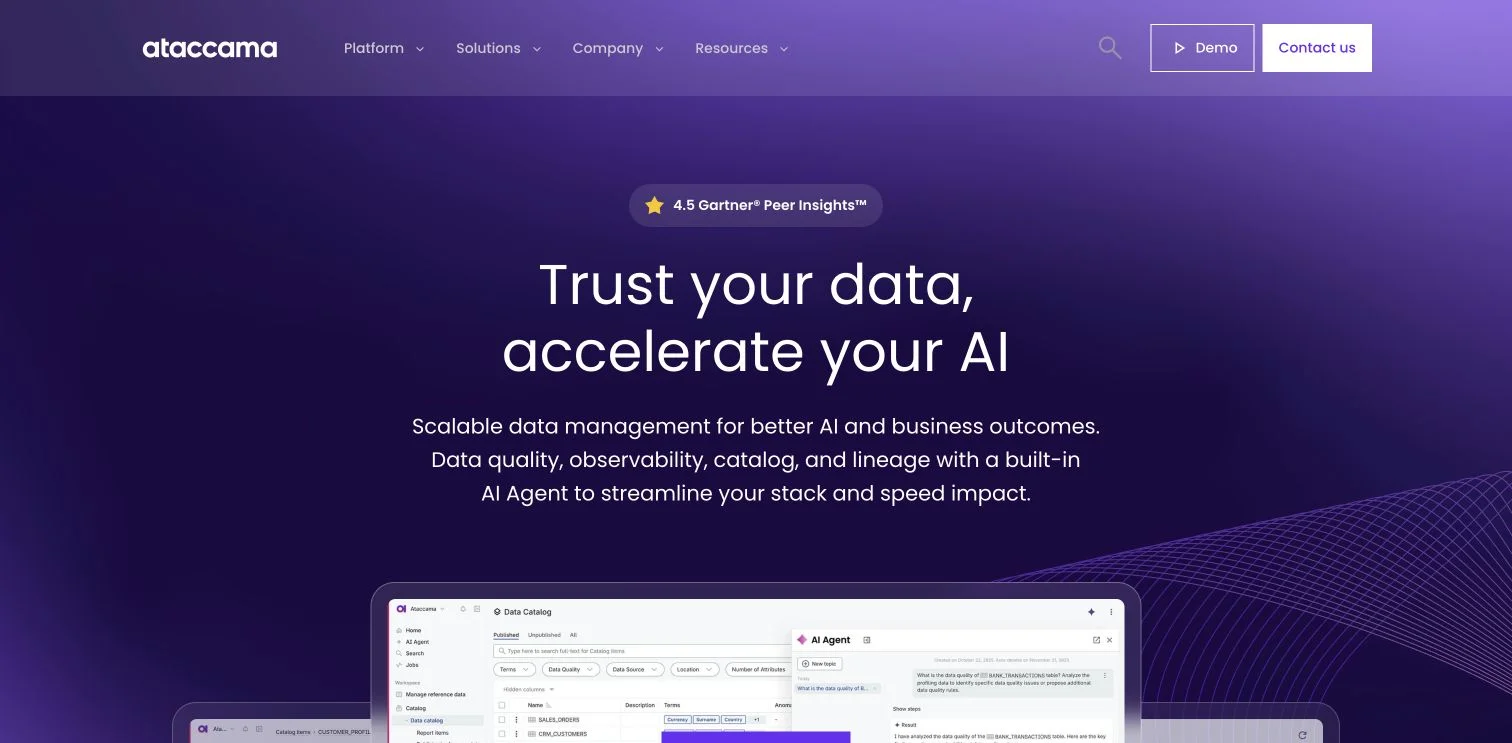
Ataccama presents data quality as part of a broader governed data-management platform with catalog, lineage, observability, and an AI agent.
How AI data quality and anomaly detection differ
AI data quality and anomaly detection excel at finding unexpected issues. A fixed rule can reject a negative order value but may miss a 60% fall in purchases from one country when the total row count remains normal.
| Product | Anomaly detection approach | Practical detail |
|---|---|---|
| Anomalo | Unsupervised models compare recent data with learned historical behavior | Anomalo says its table-anomaly check samples 10,000 recent records, becomes useful after about two weeks, and improves over the next 30–60 days. Anomalo explains the process here. |
| Ataccama | Detects anomalies in profiles, values, volume, freshness, and schema while combining results with business rules | The ONE AI Agent creates rules and assesses alerts; monitors track quality and pipeline health. Ataccama documents the monitoring model. |
| Soda | Metric monitors learn normal ranges and use feedback to improve future results | Soda Cloud can calculate up to 365 days of historical metrics. Soda reports a 70% detection improvement over Facebook Prophet in an internal benchmark; treat this as a vendor result, not independent research. See the Soda quickstart. |
AI does not replace explicit controls; good programs use both:
- Known expectations: IDs cannot be null, currencies must use approved codes, and orders must reference existing customers.
- Unknown changes: a category distribution shifts, volume falls unexpectedly, or a normally unique field starts producing duplicates.
- Human context: a zero-price order may be an error, promotion, or valid cancellation; the model cannot decide that policy.
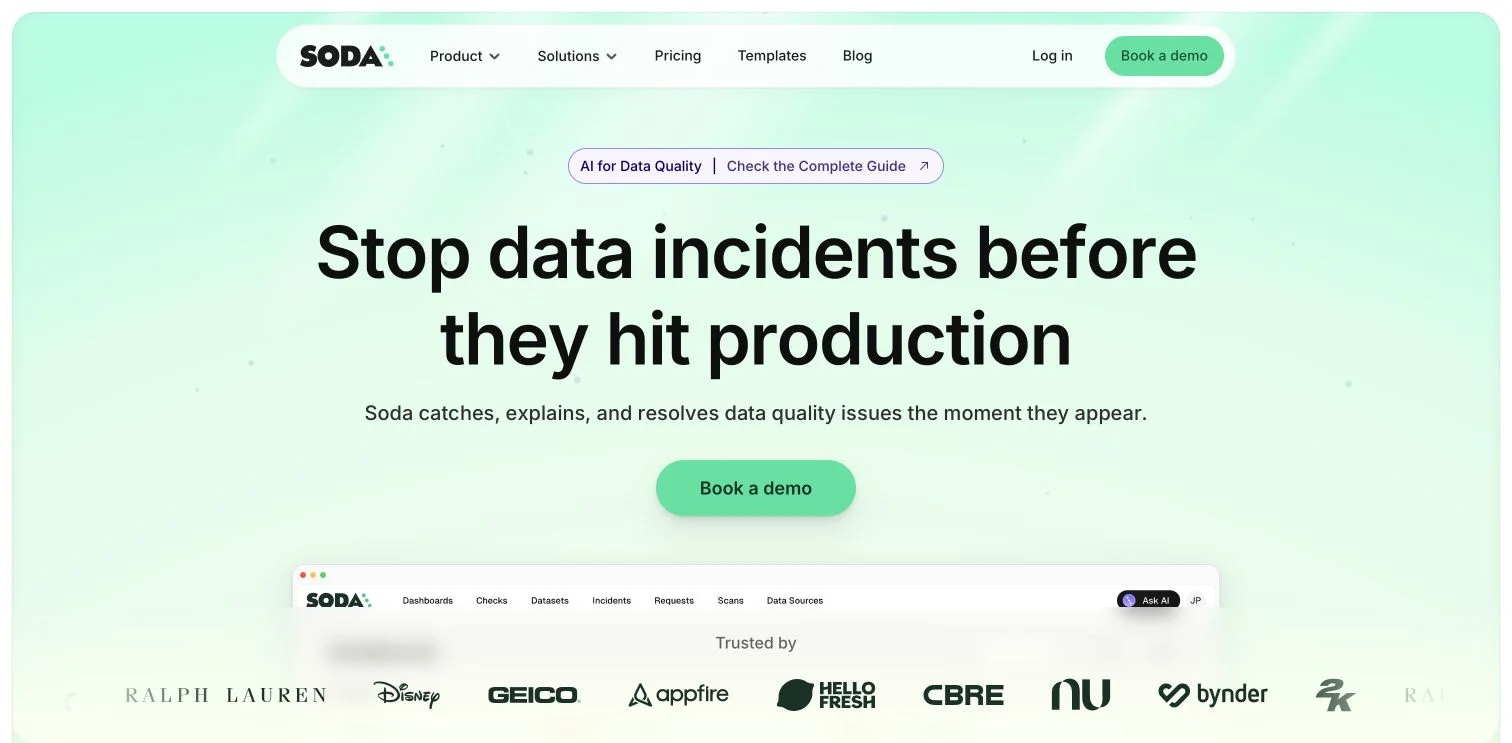
Soda emphasizes detecting, explaining, and resolving data-quality incidents before they reach production.
Data profiling and governance capabilities
Data profiling reveals a dataset’s contents before a team decides what to test. It usually measures nulls, unique values, formats, distributions, frequencies, and changes over time.
| Capability | Anomalo | Ataccama ONE | Soda data quality |
|---|---|---|---|
| Column profiling | Automatically displays value distributions and changes for monitored tables | Supports sampled or full profiling, including distributions, null counts, and frequency patterns | Profiles schemas and columns when datasets are onboarded through Soda Cloud |
| Investigation | Identifies affected segments and provides examples of good and problematic rows | Connects profiles to rules, quality scores, alerts, lineage, and issue workflows | Shows metric history, expected ranges, anomalies, contract failures, and incidents |
| Business context | Pulls context from catalog integrations such as Alation, Atlan, DataHub, and Microsoft Purview | Includes a native catalog, glossary, stewardship model, term detection, and reference data | Stores ownership and contract information and can publish results to supported catalogs |
| Remediation | Focuses on detection, root-cause analysis, and workflow integration | Includes change, standardization, cleansing, and managed remediation | Converts expectations into contracts that can reject or isolate failures in a pipeline |
Anomalo’s profiling documentation describes visual column profiles and historical changes. Ataccama’s platform goes further into governed rules and cleansing. Soda 4 connects reactive observability with preventive testing.
Ataccama may be excessive for narrow monitoring. For regulated data, combining profiling, definitions, ownership, lineage, and remediation can reduce handoffs.
Data quality tool integration and deployment options
Features mean little if the product cannot safely run against key databases. During a proof of concept, check the connector, authentication, network path, and processing mode.
| Area | Anomalo | Ataccama ONE | Soda |
|---|---|---|---|
| Data systems | More than 17 sources, including Snowflake, Databricks, BigQuery, Redshift, Athena, Oracle, PostgreSQL, and SQL Server | Broad database, warehouse, storage, BI, and application support; JDBC or API connectors can extend coverage | Soda Core v4 lists Snowflake, Databricks, BigQuery, PostgreSQL, DuckDB, Spark, SQL Server, Synapse, Athena, Fabric, and Redshift |
| Pipeline tools | Airflow and dbt integrations, APIs, SDK, and webhooks | OpenLineage connections for Airflow, dbt Core, Dagster, AWS Glue, Azure Data Factory, and Cloud Data Fusion | CLI, Python, Soda Agent, CI/CD execution, and scheduled Cloud verification |
| Notifications | Slack, Microsoft Teams, PagerDuty, Opsgenie, Jira, email, and webhooks | Slack, Microsoft Teams, email, Jira, and ServiceNow workflows | Slack, Microsoft Teams, Jira, PagerDuty, email, and webhooks |
| Deployment | Hosted SaaS, in-VPC deployment, and a Snowflake Native App | Cloud control plane with edge processing and self-managed edge options | Open-source Core, Soda-hosted Agent, or self-hosted Agent connected to Soda Cloud |
See Anomalo integrations, Ataccama supported connectors, and Soda Core data sources.
Ataccama currently documents Snowflake and Databricks pushdown execution. Anomalo offers deployments that keep data in the customer-controlled environment. Soda supports a self-hosted Agent for greater infrastructure control. For each, test read permissions, row-sample handling, secrets management, and warehouse compute from recurring scans.
Data quality tools pricing and total cost
Pricing was checked in July 2026; confirm it because contracts, minimums, and included features may change.
| Product | Public pricing information | Cost questions to ask |
|---|---|---|
| Anomalo | No public list price. A customer page describes per-table, not per-user, pricing. Available through major cloud marketplaces. | Which tables count, how often they can run, and whether observability, deep profiling, lineage, or agent features are separate charges |
| Ataccama ONE | Custom quote. Ataccama describes soft volume limits, average usage rather than penalties for short spikes, and no retrospective overage charges. | Which ONE modules, data volumes, environments, edge runtimes, services, and support levels are included |
| Soda | The public pricing page advertises a free plan for up to three production datasets, a Team model at $8 per additional dataset per month with 20 included, an optional Business UI at $250 per month, and custom Enterprise pricing. | Which AI, contract, deployment, governance, and support features require Enterprise licensing |
Licensing is only part of the cost. Also compare:
- Warehouse queries and storage used by profiling and historical metrics
- Engineering time for connections, permissions, contracts, and alert routing
- Data-steward time spent reviewing false positives
- Professional services, training, private deployment, and premium support
Anomalo’s table-based model may suit teams monitoring selected important assets. Soda’s published entry point simplifies budgeting for a small technical trial. Ataccama’s broader platform can replace several products, but assess its quote against the full setup scope. Ataccama explains its licensing principles here.
Real-world AI data quality and anomaly detection examples
Vendor case studies show scale but are not controlled comparisons. Three published examples illustrate different operating models.
-
ADP and Anomalo: ADP expanded from 700 manual checks to more than 16,000 daily ML-powered validations. Its governance team reported data-quality time falling from 70% to 30%. Read the ADP case study.
-
SSEN Transmission and Ataccama: The UK utility replaced spreadsheet reconciliation with shared catalog, glossary, and monitoring. It reported 99% cross-system consistency for a priority asset dataset, a 15-percentage-point improvement within months. Read the SSEN Transmission case study.
-
2K Games and Soda: In under a year, 2K grew from zero automated production checks to 1,945 checks across 984 datasets. It reported a 95% data quality service level, alerts within minutes, and schema breaks caught before merge. Read the 2K case study.
-
A marketing pipeline example: Suppose an on-time campaign table omits paid-search records from France. Anomalo may detect the distribution change without a rule. Ataccama can link the alert to ownership and a governed country-code list. Soda can encode the requirement in a contract that blocks the next incomplete load.
How to choose: Anomalo vs Ataccama vs Soda
Start with how the team wants to work, not the longest feature list.
| Priority | Product to examine first | Reason |
|---|---|---|
| Find unexpected changes quickly across a modern warehouse | Anomalo | Automated profiling and unsupervised monitoring require relatively little rule authoring |
| Combine quality with governance, cataloging, cleansing, and stewardship | Ataccama ONE | These capabilities share one metadata and workflow model |
| Put quality expectations in Git and enforce them in CI/CD | Soda | Open-source Core and executable contracts suit engineering-led processes |
| Give non-technical owners a no-code interface | Anomalo or Ataccama | Both put substantial configuration and investigation in visual interfaces; Soda Cloud also offers no-code contract workflows |
| Begin with a small, self-managed technical trial | Soda Core | The open-source engine provides a direct path to testing contracts against supported sources |
Common questions have straightforward answers:
A practical 30-day data quality tools comparison plan
Avoid comparing the tools on a perfectly clean demonstration table. Use production-like history, known business rules, and controlled failures in a safe environment.
| Period | Action | Evidence to collect |
|---|---|---|
| Days 1–5 | Select 5–10 important datasets used by marketing, finance, operations, or AI systems. Record owners and expected update times. | Current incident rate, manual checking time, and downstream consumers |
| Days 6–12 | Connect each product with read-only permissions and enable profiling. Add five known rules, such as uniqueness, freshness, accepted codes, and required fields. | Setup hours, profile depth, query cost, and rule-authoring effort |
| Days 13–21 | Introduce safe test failures: missing rows, delayed loads, duplicate IDs, schema changes, and a subtle category shift. | Detection rate, time to alert, explanation quality, and missed failures |
| Days 22–30 | Route alerts to the real support channel and let stewards investigate them. Review security and pricing with the vendor. | False positives per dataset, investigation time, access controls, and projected annual cost |
Use one scorecard for all three products:
- Percentage of planted failures detected
- False alerts per monitored dataset per week
- Median time from failure to useful notification
- Time required to add or change a business rule
- Warehouse compute cost per scan
- Percentage of important datasets with a named owner
The winner should remain operable after the vendor leaves, not merely produce the most alerts in a polished demo.
Conclusion
A clear operating goal simplifies the Anomalo vs Ataccama decision. Soda belongs because it offers a contract-led route from anomaly detection to prevention.
- Anomalo fits automated anomaly discovery and fast monitoring coverage.
- Ataccama ONE fits organizations that need quality, governance, cataloging, lineage, and remediation together.
- Soda data quality fits teams that want open-source foundations, executable contracts, and CI/CD enforcement.
All three still require owners, business definitions, and incident processes. AI identifies unusual data; people decide whether it is wrong and how to respond. Next, run a 30-day pilot using the same production-like datasets, injected failures, cost measures, and alert-quality scorecard for each candidate.
Frequently asked questions
Can AI replace business rules?
No. AI can find surprising patterns, but the business must define whether a tax code, product state, or cancellation value is valid.
Can these tools prevent bad production data?
Yes, through pipeline gates. Anomalo can control workflow completion, Ataccama provides DQ Gates and firewalls, and Soda contracts can fail verification before promotion.
Which product is easiest?
Soda Core suits engineers, while Anomalo emphasizes low-configuration monitoring. Ataccama’s broader scope usually requires broader organizational decisions.
Which data quality tool should my team evaluate first?
Start with Anomalo if you need low-configuration detection of unexpected warehouse changes. Consider Ataccama ONE first for a broader governance, cataloging, cleansing, and stewardship program, or Soda if engineers need contracts and tests embedded in Git and CI/CD.
Can AI anomaly detection replace manually defined data quality rules?
No. AI can uncover unusual patterns that teams did not anticipate, while explicit rules enforce known requirements such as unique IDs, approved codes, and required relationships. A reliable program combines both approaches with human review of business context.
Can these tools stop bad data before it reaches production?
Yes, each platform supports some form of pipeline gate or workflow control. Teams can fail or pause processing when critical checks do not pass, but should define severity levels carefully so minor warnings do not unnecessarily block valid data.
How long does anomaly detection take to become useful?
It depends on the product, available history, and data frequency. Some models begin producing useful results after roughly two weeks, while longer histories can improve seasonal baselines; explicit rules can provide protection immediately.
What costs should be compared beyond the software license?
Include warehouse compute, profiling storage, implementation work, alert investigation, training, support, and private deployment costs. Also estimate the staff time needed to maintain rules, contracts, permissions, ownership records, and incident workflows.
How should we test Anomalo, Ataccama, and Soda fairly?
Run each tool against the same production-like datasets, known business rules, and safely injected failures. Compare detection rates, false positives, alert speed, investigation effort, setup time, warehouse cost, and projected annual expense over a structured 30-day pilot.
What security and deployment issues should we verify during a pilot?
Confirm connector support, authentication, network paths, read permissions, secrets management, row-sample handling, and where processing occurs. Test whether an in-VPC, edge, native, or self-hosted deployment meets your organization’s data residency and infrastructure-control requirements.
Related Articles
12 Best Data Quality Tools for AI Monitoring
Compare 12 data quality tools for profiling, anomaly detection, observability, and database monitoring, plus selection and rollout tips.
Databricks vs Looker: BI Architecture Guide
Compare Databricks AI/BI and Looker across architecture, governance, performance, cost, AI analytics, and hybrid deployment options.
12 Best Data Catalog Software Tools for 2026
Compare the 12 best data catalog tools for 2026, including AI features, governance, lineage, pricing, deployment, and ideal use cases.