Vanna vs Text2SQL.ai: Enterprise Comparison
Table of Contents
- Vanna vs Text2SQL: the short answer
- How enterprise text to SQL converts natural language to SQL
- Vanna vs Text2SQL: an enterprise text to SQL comparison at a glance
- Customization in the Vanna vs Text2SQL decision
- Accuracy: how to run a fair text to SQL comparison
- Enterprise text to SQL deployment and security
- Four enterprise natural language to SQL examples
- A practical Vanna vs Text2SQL pilot
- Vanna vs Text2SQL conclusion: choosing Vanna.ai or Text2SQL.ai
- Vanna vs Text2SQL: the short answer
- How enterprise text to SQL converts natural language to SQL
- Vanna vs Text2SQL: an enterprise text to SQL comparison at a glance
- Customization in the Vanna vs Text2SQL decision
- Accuracy: how to run a fair text to SQL comparison
- Enterprise text to SQL deployment and security
- Four enterprise natural language to SQL examples
- A practical Vanna vs Text2SQL pilot
- Vanna vs Text2SQL conclusion: choosing Vanna.ai or Text2SQL.ai
Vanna vs Text2SQL: the short answer
There is no universal winner: the choice depends on how much control your company wants. Vanna is an open-source framework for database assistants using your models, infrastructure, permissions, and business rules. Text2SQL.ai is a managed service that connects to a database and generates SQL from questions with less engineering.
TL;DR: The choice usually comes down to:
- Choose Vanna for customization, private infrastructure, model choice, or application integration.
- Choose Text2SQL.ai for a managed interface and faster deployment.
- Test both when accuracy is the deciding factor. Neither vendor publishes a neutral head-to-head benchmark on your schema.
This guide covers how the products differ, what enterprise text to SQL requires, and how to run a useful pilot.
How enterprise text to SQL converts natural language to SQL
Enterprise text to SQL converts requests such as “Which campaigns produced the most paid revenue last quarter?” into a database query. In practice, it must identify the tables containing campaign costs, opportunities, invoices, currencies, and payment dates. It must know your definition of paid revenue.
A typical request passes through five stages:
- The system receives the question and user identity.
- It retrieves relevant table definitions, column descriptions, business rules, and approved examples.
- A language model generates dialect-correct SQL.
- The application validates and, if permitted, sends the query to the database.
- It returns a table, explanation, or chart.
You cannot judge an enterprise text to SQL or AI database query tool by model quality alone. A strong model with weak schema information may join the wrong tables, while a smaller model with good definitions and approved examples may perform better.
First, document:
- The databases and SQL dialects in scope
- Business terms that do not appear in the schema
- Data each user group may access
- Whether generated SQL may run automatically
- The expected response time and query cost
This often exposes more risk than a polished demonstration.
Vanna vs Text2SQL: an enterprise text to SQL comparison at a glance
The central difference is product shape. Vanna 2.0 describes itself as a user-aware agent framework and its source code is available under the MIT license. Text2SQL.ai is primarily a hosted application and API, with private deployment listed as an Enterprise option.
| Area | Vanna.ai | Text2SQL.ai |
|---|---|---|
| Product model | Open-source Python framework with optional commercial services | Managed web application and API |
| Initial setup | Requires development, model configuration, database access, and hosting | Account setup, schema import, connection configuration, and optional API integration |
| Model choice | Supports OpenAI, Anthropic, Azure OpenAI, Gemini, Ollama, and custom adapters | Public privacy documentation says the service uses OpenAI’s API |
| Database context | Tool Memory, approved query examples, prompts, custom tools, and custom retrieval | Imported schema, selected tables and columns, schema comments, templates, and conversation history |
| Deployment | Local infrastructure, customer cloud, or commercial Vanna-managed deployment | Hosted service; private deployment is offered for Enterprise customers |
| Permissions | Integrates with an existing identity system and supports group-based tool access | Shared teams with Owner and Member roles; Enterprise documentation lists SSO |
| Built-in safety | Determined largely by your database roles, tools, middleware, and application code | Safe Mode blocks write and schema-changing statements by default |
| Best fit | Teams that want control and have software or data engineering resources | Teams that want to start quickly with limited setup work |
Vanna.ai offers more freedom, which creates work. Your team handles upgrades, monitoring, secrets, model selection, testing, and most operations.
Text2SQL.ai removes much of that work, but its hosted design offers less control over the processing path.
Start with operating capacity. Without Python-service maintenance, Vanna’s open-source license does not make it free. If policy prohibits sending schema or prompts through a shared service, a hosted interface cannot solve deployment.
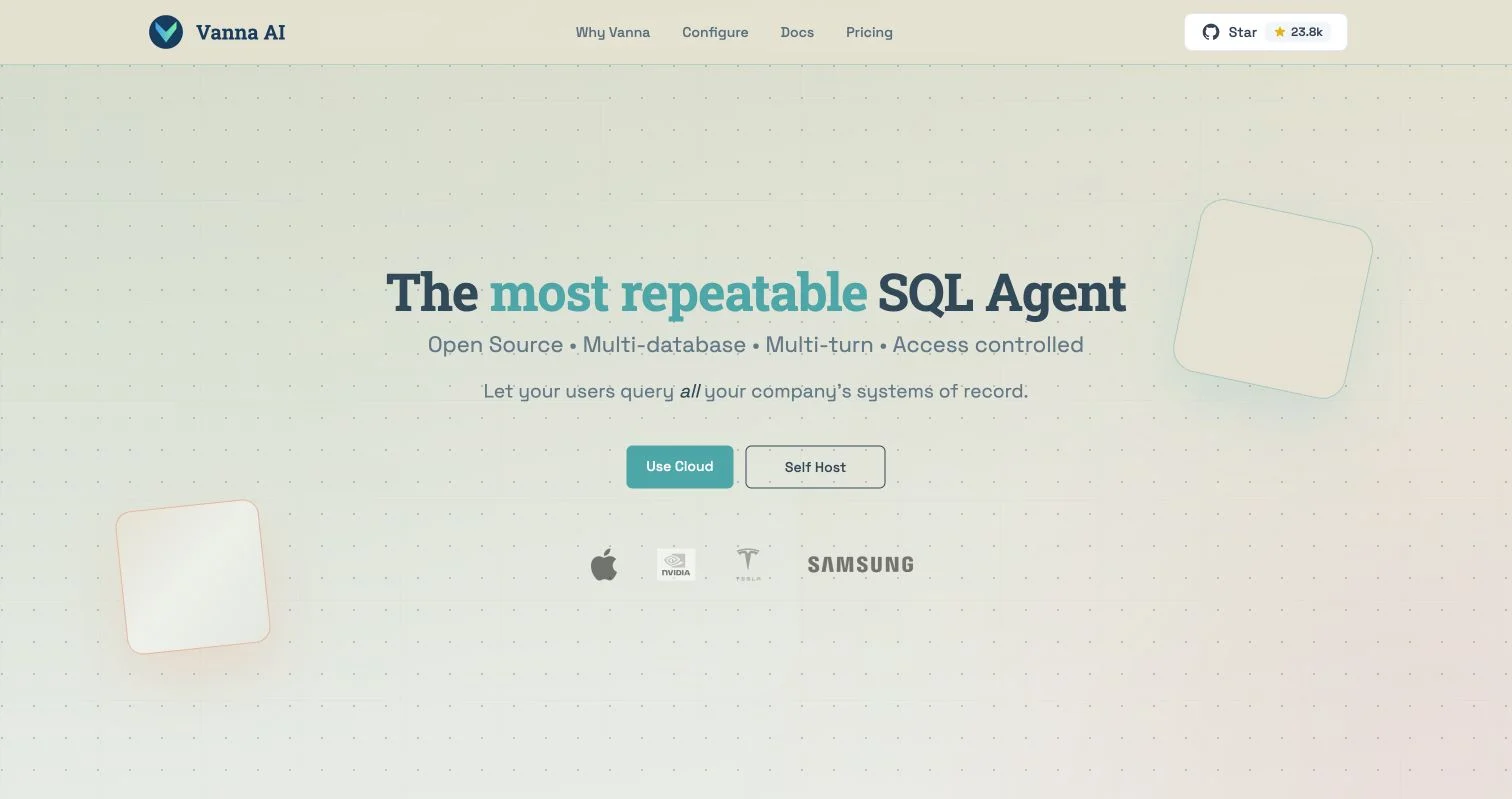
Vanna AI positions its product as an open-source, access-controlled SQL agent that can connect to multiple databases.
Customization in the Vanna vs Text2SQL decision
Vanna.ai is more adaptable. Developers can register SQL, visualization, export, or company tools; use existing authentication; and embed the agent in a web application. Its configuration guide provides selectable examples for several model providers and databases. Saving successful tool use to memory lets later questions reuse known patterns.
Text2SQL.ai provides customization through configuration, not application code. Its connection workflow lets users import a schema, exclude irrelevant objects, and add comments to tables or columns. Its API supports conversational requests, query execution, explanations, charts, and error correction. When execution is enabled, the service can make up to three correction attempts after SQL errors, according to its API documentation.
| Customization question | What to test |
|---|---|
| Can the tool understand internal metrics? | Define terms such as active customer, qualified lead, and recognized revenue, then ask questions that depend on each definition. |
| Can it follow existing permissions? | Sign in as users from two departments and confirm that their available tools and returned rows differ correctly. |
| Can approved SQL be reused? | Add a verified query and test several natural-language variations of the original request. |
| Can the interface fit your workflow? | Try the web interface and an API integration rather than judging screenshots alone. |
| Can context be corrected safely? | Check who may edit schema comments, examples, prompts, and saved memories. |
Neither approach is traditional model fine-tuning. Most practical improvement comes from better request-time context. Vanna uses tools, prompts, retrieval, and saved examples; Text2SQL.ai mainly uses schema selection, descriptions, templates, and conversation context.
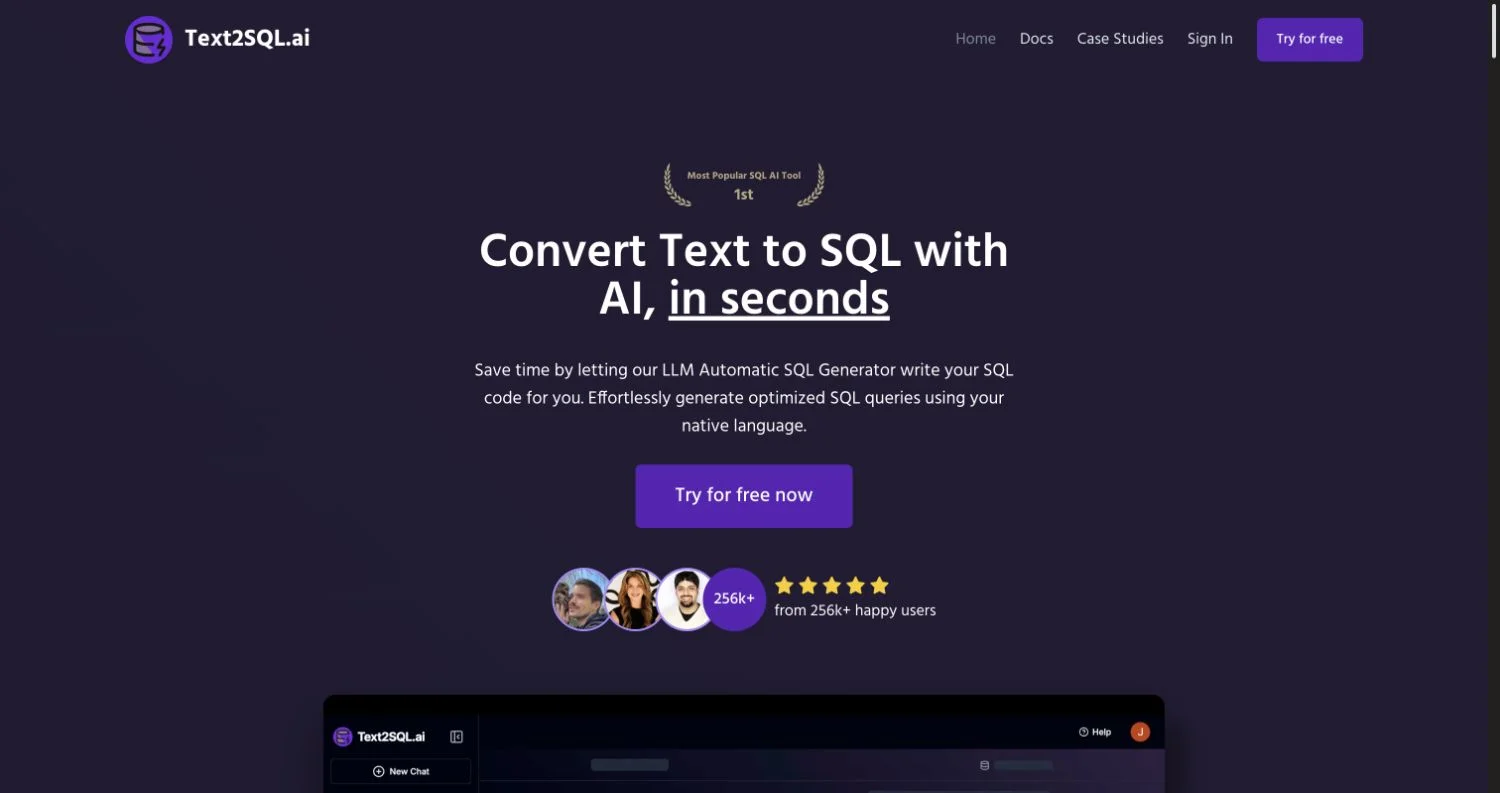
Text2SQL.ai emphasizes fast natural-language query generation, hosted access, and a guided product experience.
Accuracy: how to run a fair text to SQL comparison
No credible public statistic shows either product is always more accurate. Results depend on the selected model, schema quality, business definitions, SQL dialect, saved examples, and question difficulty. Vanna is hard to score because its model and retrieval components are replaceable.
The BIRD benchmark contains more than 12,751 question-SQL pairs, 95 databases, 33.4 GB of data, and over 37 professional domains. The newer Spider 2.0 benchmark includes 632 enterprise workflow problems using databases that often contain more than 1,000 columns. Some expected solutions exceed 100 SQL lines.
In the original Spider 2.0 evaluation, an o1-preview agent solved only 17.0% of tasks, versus 91.2% on Spider 1.0 and 73.0% on BIRD. These benchmarks do not score either product, but show that success on small academic schemas does not guarantee success on an enterprise warehouse.
Measure:
- Execution success: Does the query run without an error?
- Result accuracy: Are the records and totals correct?
- Business-rule accuracy: Does it correctly apply company definitions?
- Safe-failure rate: For ambiguous requests, does it clarify rather than guess?
- Efficiency: How much data does the query scan, and how long does it run?
- Permission accuracy: Can the user see only authorized data?
A query can run yet be wrong, perhaps double-counting revenue after a one-to-many join or filtering by order instead of payment date. Compare results with verified answers, not one preferred SQL string; different statements can produce the same correct result.
Enterprise text to SQL deployment and security
Self-hosted Vanna can run near a private database using a company-approved model endpoint. Vanna also documents a commercial deployment path for workloads operated in a customer’s cloud. Self-hosting is private only across the full data path; prompts, schema details, or results sent to an external model API still leave the environment.
Text2SQL.ai is normally hosted. Direct connections support PostgreSQL, MySQL, and SQL Server; its documentation covers schema extraction for several others. Cloud connections may require a static IP allowlist, public reachability, or a secure tunnel. Although Enterprise lists private deployment and SSO, buyers should verify the architecture before treating those labels as guarantees.
| Security area | Vanna.ai | Text2SQL.ai |
|---|---|---|
| Data location | Controlled by the customer in a self-managed installation, apart from any external services selected | Depends on the hosted or negotiated private deployment |
| Query protection | Customer configures database roles, tool permissions, validation, timeouts, and middleware | Safe Mode parses SQL and blocks writes, schema changes, and permission changes by default |
| Authentication | Customer connects existing cookies, tokens, or identity provider to Vanna’s user context | Hosted login and team roles; Enterprise materials list SSO |
| Operational responsibility | Mostly the customer for open-source deployments | Mostly the vendor for hosted deployments |
Text2SQL.ai’s privacy policy says database schemas and queries are processed through OpenAI’s API and are not used for model training. Its security documentation says connection information is encrypted and database data is not retained. Enterprise reviews should ask about:
- Regions where schemas, prompts, chat history, and query results are processed
- Retention periods and deletion procedures
- Audit logs, incident notification, backups, and staff access
- Subprocessors, contractual controls, and independent security reports
Use read-only database credentials even with a SQL safety filter, plus statement timeouts and row limits. A read-only query cannot delete a table, but it can still expose sensitive rows or scan an expensive warehouse.
Four enterprise natural language to SQL examples
These scenarios show how requirements can change the preferred product. They are selection examples, not customer claims.
| Scenario | Example request | Main difficulty | Likely starting point |
|---|---|---|---|
| Marketing attribution | “Show paid revenue and acquisition cost by campaign for customers acquired last quarter.” | Joining advertising, CRM, invoice, and payment data while applying the company’s attribution rule | Vanna when custom attribution tools and approved SQL must be embedded; Text2SQL.ai when the required schema can be documented clearly |
| IT incident reporting | “Compare login failures by application before and after yesterday’s deployment.” | Restricted security data, time zones, deployment windows, and large event tables | Vanna for a tightly controlled private service with custom access rules |
| Department self-service | “List this month’s open orders that are more than seven days late.” | A straightforward query over a documented operational schema | Text2SQL.ai for a quick managed rollout with Safe Mode and read-only credentials |
| Customer-facing analytics | “How did my stores perform against their targets?” | Tenant isolation, application authentication, row-level permissions, and predictable API behavior | Vanna for deep application control; evaluate a private Text2SQL.ai deployment if the vendor can meet the isolation design |
The marketing example tests accuracy because several plausible answers may be wrong. Queries might assign revenue to the first, last, or every campaign touch. The schema cannot resolve that policy; the system needs an explicit definition or must ask which attribution method to use.
The department example is simpler. With one documented meaning of “late” and clean database relationships, a custom service may be unnecessary. Here, Text2SQL.ai’s convenience is easiest to justify.
A practical Vanna vs Text2SQL pilot
Pilot with real questions and a restricted copy or read replica of real data. A toy database tests the interface, not production accuracy.
-
Create an evaluation set. Collect 50–100 questions from marketers, analysts, and IT staff. Cover simple filters, multi-table joins, date logic, window functions, vague requests, and questions the system should refuse.
-
Record verified answers. Have an analyst write or approve expected results. Save business-rule explanations to distinguish model errors from unclear requirements.
-
Apply the same context. Give both products the same schema descriptions, glossary entries, and approved examples. Otherwise, it measures preparation quality, not product performance.
-
Protect the database. Use a read-only account for approved views; add query timeouts, row limits, cost limits, and logs. Disable automatic execution until validation passes.
-
Measure by risk level. Reasonable internal targets might be at least 95% result accuracy for recurring low-risk reports and 100% prevention of unauthorized access. A lower threshold can suit exploratory questions if every query is reviewed.
-
Run a limited user trial. Give 10–20 people access for two weeks. Track corrections, clarification requests, response time, scanned data, support work, and repeated questions. Interview users who stopped; silent abandonment rarely appears in accuracy charts.
Use this checklist:
| Item | What to check | Why it matters |
|---|---|---|
| Schema changes | Tables, columns, and descriptions can be refreshed without losing reviewed context | Stale metadata creates plausible but invalid SQL |
| Saved examples | Only approved queries enter shared memory or templates | A wrong example can spread the same error to later requests |
| Ambiguity handling | The assistant asks what “best,” “active,” or “recent” means | Guessing turns unclear language into confident errors |
| Query cost | Tests record execution time and bytes scanned | Correct SQL can still be too expensive for routine use |
| Ownership | A named team maintains definitions, permissions, and test cases | Enterprise text to SQL needs ongoing care after launch |
Compare total cost, not subscription price alone. For Vanna, count engineering time, infrastructure, monitoring, model usage, security reviews, and upgrades. For Text2SQL.ai, count seats, API credits, integration work, support terms, and private deployment charges. The cheaper demonstration may cost more in production.
Vanna vs Text2SQL conclusion: choosing Vanna.ai or Text2SQL.ai
The choice is mainly between control and convenience. Vanna suits organizations needing custom tools, model flexibility, application integration, or self-operated deployment. Text2SQL.ai suits teams wanting a hosted interface, schema-guided SQL, an API, and built-in read-only protection.
Do not infer accuracy from product design. Test both on verified database results, including ambiguous requests, business definitions, permissions, and expensive queries.
Next, prepare 50 representative questions, connect a read-only test database, and measure the workflow. A disciplined pilot reveals more than a generic comparison by testing whether the AI database query tool understands your data and rules.
Frequently asked questions
Should my company choose Vanna or Text2SQL.ai?
Choose Vanna when you need extensive customization, model flexibility, private infrastructure, or deep application integration. Choose Text2SQL.ai when faster deployment and a managed interface matter more than controlling every component. If accuracy is the deciding factor, test both against verified answers from your own database.
Does self-hosting Vanna keep all data private?
Not automatically. While Vanna can run within your infrastructure, schema details, prompts, or query results may still leave the environment if you use an external model or service. Review the complete data path, including model endpoints, logging, storage, and monitoring.
Can Text2SQL.ai connect directly to a production database?
It can connect to supported databases, but a direct production connection should use a restricted, read-only account. Add approved views, statement timeouts, row and cost limits, and audit logging. Start with automatic execution disabled until the generated queries pass validation.
How can we improve text-to-SQL accuracy for internal business terms?
Document terms such as “active customer,” “paid revenue,” and “qualified lead” with precise rules and examples. Provide relevant schema descriptions and analyst-approved queries as request-time context. When a term remains ambiguous, the assistant should ask a clarifying question instead of guessing.
What should we measure during a Vanna versus Text2SQL.ai pilot?
Measure result accuracy, business-rule accuracy, execution success, safe failures, permission enforcement, response time, and query cost. Compare returned records and totals with analyst-verified answers rather than requiring one exact SQL statement. Include ambiguous, unauthorized, and expensive requests alongside routine reporting questions.
How large should a practical evaluation be?
Start with 50–100 representative questions from actual users and run a limited trial with roughly 10–20 people. Cover simple filters, complex joins, date logic, vague requests, and questions the system should refuse. Use a restricted copy or read replica of realistic data rather than relying only on a toy schema.
Is an open-source Vanna deployment necessarily cheaper?
No. Its license may reduce software fees, but your company still owns engineering, hosting, monitoring, model usage, security reviews, upgrades, and support. Compare that total operational cost with Text2SQL.ai’s seats, API usage, integration work, support terms, and any private-deployment charges.