12 Best SQL Interview Prep Tools for 2026
Table of Contents
- What SQL interview questions really test
- How to choose SQL interview tools for effective prep
- AI SQL tutor tools and coaches for SQL practice
- Real SQL interview questions for data-role prep
- SQL coding interview tools for timed SQL practice
- Courses for building SQL foundations with AI
- A four-week SQL interview prep plan
- SQL Practice Mistakes
- Build a SQL interview prep stack you will use
- What SQL interview questions really test
- How to choose SQL interview tools for effective prep
- AI SQL tutor tools and coaches for SQL practice
- Real SQL interview questions for data-role prep
- SQL coding interview tools for timed SQL practice
- Courses for building SQL foundations with AI
- A four-week SQL interview prep plan
- SQL Practice Mistakes
- Build a SQL interview prep stack you will use
What SQL interview questions really test
SQL interview questions look simple until the timer starts. You may know JOIN, GROUP BY, and window functions yet struggle with unfamiliar schemas, the right level of detail, or duplicate and missing values.
TL;DR: Good SQL interview prep combines hands-on practice, tested queries, and clear explanations. Write queries against real tables, inspect the output, correct mistakes, and explain your reasoning aloud. AI can diagnose errors and create follow-up questions, but an execution engine must verify the query.
This guide compares 12 tools across:
- Learning SQL from the beginning
- Solving realistic SQL interview questions
- Practicing under SQL coding interview conditions
- Receiving AI feedback on logic and communication
I checked each tool’s features and access model in July 2026.
How to choose SQL interview tools for effective prep
Start with the role. Marketing analysts may face campaign attribution, conversion funnels, and cohort retention; data engineers, sessionization, slowly changing dimensions, and query performance; and software engineers, shorter database puzzles.
Let the role determine your question bank, SQL dialect, and preferred feedback style. My view: paying for similar libraries rarely helps. One learning tool, realistic question bank, and SQL mock interview tool usually suffice.
| Tool | Best for | Feedback style | Access |
|---|---|---|---|
| SQL Quest | Adaptive SQL practice | AI coach and skill tracking | Free core, paid depth |
| Queryflo | Marketing and business analytics | AI review and business explanations | Free and Pro |
| StrataScratch | Analyst and data science interviews | Execution, solutions, and AI mocks | Free and paid |
| Interview Query | Mixed data interview rounds | Guided solutions and AI interviewer | Samples and paid plans |
| DataDriven | Data engineering roles | Real execution and AI evaluation | Listed as free |
| DataLemur | Company-style analytics questions | Hints and worked solutions | Free and paid access |
| LeetCode SQL 50 | High-volume coding practice | Automated tests and discussions | Free and Premium |
| HackerRank SQL | Timed assessments | Automated grading and certificates | Free |
| CodeSignal Learn | Guided, interactive learning | Context-aware AI tutor | Free and paid access |
| DataCamp | Structured SQL courses | AI tutor and exercises | Samples and subscription |
| Codecademy | Beginners who need guidance | AI learning assistant | Free and paid access |
| Mode SQL Tutorial | Analytics foundations | Browser exercises and real datasets | Free |
The 2025 Stack Overflow survey contextualizes these AI features: 82% of respondents to its large-language-model question said they had used OpenAI GPT models for development work. AI is common, but generated SQL still requires testing against data and edge cases. The survey recorded 16,474 responses to that question.
AI SQL tutor tools and coaches for SQL practice
These tools help when correct-or-incorrect feedback is insufficient. An AI SQL tutor can examine queries, explain mistakes, and suggest what to practice next.
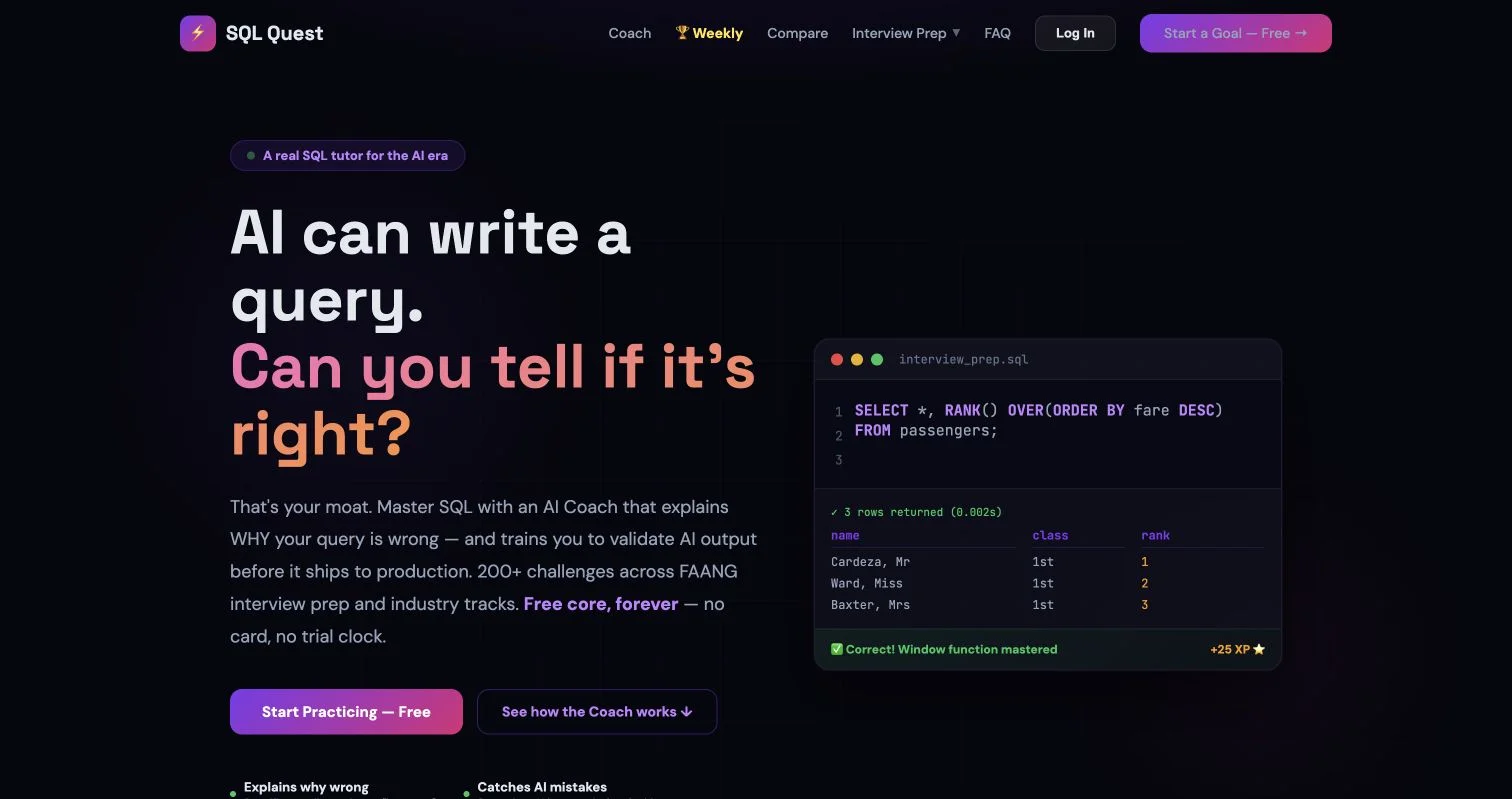
SQL Quest combines an AI coach, SQL exercises, and interview-focused practice in a no-setup browser experience.
-
SQL Quest suits learners who get stuck without knowing why. Its AI coach uses a skill radar and earlier sessions to recommend the next exercise. The site lists over 200 challenges, including roughly 120 free easy and medium problems. Company-tagged exercises and timed mocks support focused SQL interview prep. The risk is using progressive hints too soon. Make a full attempt before opening them.
-
Queryflo is practical for marketing professionals and business analysts. Its 100 challenges cover growth, SaaS, marketing, product, and finance data. Eight AI tools explain queries, flag issues such as missing
NULLhandling, answer schema questions, and produce brief business summaries. For example, a cohort-retention exercise tests calculating a percentage and explaining why one cohort performed differently. That resembles real analyst work more than a syntax puzzle. -
StrataScratch combines a large question bank with AI mock interviews. The platform reports over 1,000 coding and concept questions from 200-plus companies and supports PostgreSQL, MySQL, SQL Server, and Oracle. Its mock mode scores correctness, code quality, and communication. Choose it for analyst or data scientist interview practice rather than general software puzzles.
Real SQL interview questions for data-role prep
Question banks work best after you learn the syntax. They expose you to unfamiliar schemas and require translating business requests into precise SQL.
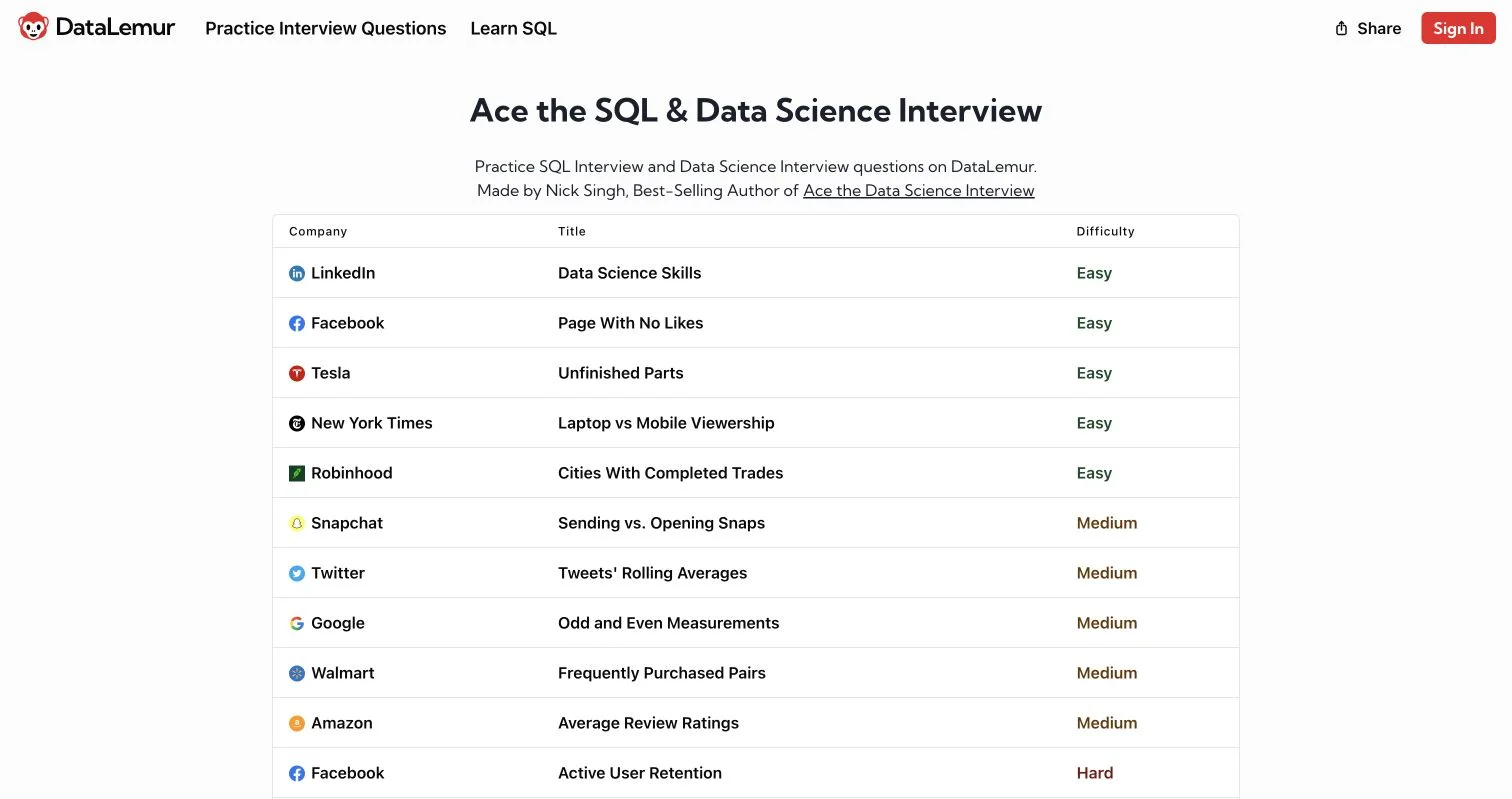
DataLemur presents company-style SQL and data-science questions with visible difficulty levels, making it easy to build a progressive practice queue.
-
Interview Query covers SQL alongside statistics, product analytics, machine learning, and data modeling. That breadth suits data analyst and scientist interviews where SQL is one round. Its AI interviewer makes candidates narrate their reasoning. In an A/B test prompt, calculate conversion by variant, state the observation grain, and explain whether duplicate events could inflate the result. This tests database thinking and query writing.
-
DataDriven focuses on data engineering SQL interview prep. Its SQL mock interview page lists over 400 questions, with real database execution and 8 to 15 edge-case checks per question. The evaluator reviews correctness, performance, readability, and cases such as duplicate timestamps or empty groups. It can ask follow-up questions after the query. The site says every feature is free, though pricing can change.
-
DataLemur offers concise SQL questions modeled on work at Amazon, Google, Meta, and LinkedIn. Problems cover rolling averages, retention, repeated purchases, and year-over-year growth. Hints and detailed solutions support early SQL practice. Its lower adaptability can help: you must struggle with the schema before seeing the solution. Use its company labels as direction, not a promise that the exact question will appear.
SQL coding interview tools for timed SQL practice
These platforms build speed through volume, automated tests, and hiring-assessment-style interfaces. Their feedback may be less personal.
-
LeetCode SQL 50 offers a one-month route through 50 basic and intermediate questions. It suits software developers expecting SQL alongside algorithm questions. Community discussions compare valid solutions, such as correlated subqueries and window functions. Before copying the shortest answer, explain how it treats ties, duplicates, and
NULLvalues. -
HackerRank SQL helps rehearse formal assessments. Its basic SQL certification requires two questions in 30 minutes, a concrete speed benchmark. The broader SQL domain progresses from simple selects and aggregation to joins and advanced queries. HackerRank offers less business interpretation than DataLemur or Queryflo, but its strict grader catches syntax and output-format errors.
-
CodeSignal Learn places an AI tutor named Cosmo beside interactive exercises. Its catalog includes the A Journey into SQL learning path, and its practice environment resembles technical-screening systems. It bridges guided lessons and assessments. Ask for a smaller hint or error explanation rather than a complete query. This preserves recall for a real interview.
After each timed SQL problem, record:
- Minutes used before the first runnable query
- Number of failed executions
- Edge cases missed
- Time needed to explain the final approach aloud
Courses for building SQL foundations with AI
Hard SQL interview questions frustrate when joins and grouping remain uncertain. A short course can close those gaps before timed practice.
-
DataCamp offers beginner and intermediate SQL courses with an AI assistant. Its intermediate SQL querying with AI course is listed at three hours, with 35 exercises covering sorting, filtering, grouping, and conditional logic. DataLab exposes generated SQL for learners to inspect, edit, and run. This helps marketers who can describe the business question but are learning how databases represent customers, campaigns, and events.
-
Codecademy combines conventional SQL prerequisites with a short Learn AI for SQL course. The course includes guided coding help, a project, quizzes, and a completion certificate. Its AI Learning Assistant uses the current instructions and submitted code, providing more context than a blank chatbot conversation. Its job-readiness checker and interview simulator may help beginners choose what to study next.
-
Mode SQL Tutorial is refreshingly simple. It teaches basic, intermediate, and advanced analytical SQL through browser exercises and datasets modeled on businesses such as Crunchbase. No AI tutor does the work for you. Pair Mode with an AI coach when you need explanations. Together they provide free foundations and targeted feedback.
Before leaving foundations, complete these tasks without generated code:
- Join two tables after identifying their relationship
- Aggregate at the requested level of detail
- Explain the difference between
WHEREandHAVING - Use
ROW_NUMBER,RANK, orDENSE_RANKintentionally - Predict how a query will treat missing and duplicate values
A four-week SQL interview prep plan
A good plan moves from untimed accuracy to timed explanation. This schedule assumes 45 to 60 minutes of SQL practice, five days a week.
-
Week 1: diagnose and repair. Take a placement test, then solve 20 foundation problems. Focus on joins, aggregation, subqueries, date functions, and
NULLbehavior. Use Mode, Codecademy, DataCamp, or SQL Quest. Log each faulty assumption, corrected query, and one-sentence explanation. -
Week 2: learn recurring patterns. Solve 20 to 25 medium questions from DataLemur, StrataScratch, or LeetCode. Group by pattern, not company. Practice top-N-per-group, running totals, deduplication, retention, and gaps-and-islands. Re-solve misses two days later without the answer.
-
Week 3: match the target role. Choose a question bank matching the job description. Complete four timed sessions. After each query, explain the table grain, join logic, edge cases, and performance trade-offs. Use AI feedback only after submitting your solution.
-
Week 4: rehearse the interview. Complete three full SQL mocks with a timer, no search, and no answer generation. Review mistakes the next day. Finish with HackerRank or a fresh LeetCode set to test whether your speed transfers.
Vary realistic cases instead of repeating one query type:
| Target role | Practice case | SQL concepts to review |
|---|---|---|
| Marketing analyst | Compare campaign spend with attributed revenue | Joins, aggregation, duplicate attribution |
| BI analyst | Calculate monthly active customers | Date grouping, distinct counts, missing months |
| Data engineer | Divide click events into user sessions | LAG, time differences, cumulative sums |
| Software developer | Find the top earners in each department | CTEs, ranking, tie handling |
SQL Practice Mistakes
The biggest prep mistake is letting AI produce the first answer. It feels effective, but recognition is easier than recall. In an interview, you must write the query from scratch and explain it under pressure.
| Mistake | Better practice | Why it matters |
|---|---|---|
| Reading solutions before attempting the problem | Work alone for 10 to 15 minutes first | Builds recall and reveals the real gap |
| Checking syntax but not results | Run against normal and edge-case data | A valid query can return the wrong answer |
| Ignoring the SQL dialect | Practice the dialect named in the job description | Date and text functions vary |
| Solving silently | Explain the grain and approach aloud | Interviewers evaluate communication |
| Memorizing company labels | Study patterns across several companies | Exact questions and schemas change |
| Using live assistance in a real interview | Follow the employer’s stated rules | Hidden assistance can invalidate the assessment |
Common concerns:
Build a SQL interview prep stack you will use
The best tool fixes your current weakness. Beginners may start with Mode, DataCamp, or Codecademy. Analyst candidates can move to Queryflo, DataLemur, or StrataScratch. Data engineers should consider DataDriven; LeetCode and HackerRank are strong for timed practice.
A simple stack is enough:
- One structured course for missing concepts
- One role-specific bank of SQL interview questions
- One AI or timed mock tool for feedback and pressure
Start with a diagnostic today. Solve one query without assistance, test it with awkward data, and explain the result aloud. That routine teaches more than another hour of reading solutions.
Frequently asked questions
Do I need a paid tool?
No. Mode, HackerRank, LeetCode SQL 50, SQL Quest, and other free tiers offer enough to begin. Pay when you need deeper company filters, hard problems, or repeated mock interviews.
How many SQL interview questions should I solve?
No total is magic: 60 well-reviewed problems beat 200 copied solutions. Move on when you can solve fresh medium questions, explain them, and handle edge cases consistently.
Which dialect should I learn?
Use the employer’s dialect when known. PostgreSQL is a practical default, with broad analytical features and wide training-tool support.
Should I use AI during SQL interview prep?
Yes, after your first attempt. Ask it to identify a faulty assumption, generate an edge case, or challenge your explanation. Always run the revised query.
How should I choose an SQL interview-prep platform?
Match the platform to the role, SQL dialect, and type of interview you expect. Beginners benefit from structured lessons, while experienced candidates may need role-specific questions, timed assessments, or mock interviews with feedback.
Can I prepare effectively using only free SQL tools?
Yes. Free tutorials, question banks, and automated graders can cover fundamentals and provide substantial practice. A paid plan is most useful when you need advanced problems, company-specific filters, detailed coaching, or repeated mock interviews.
How many SQL problems should I complete before an interview?
Prioritize mastery over a fixed total. You are approaching readiness when you can solve unfamiliar medium-difficulty problems, test edge cases, and clearly explain your reasoning without relying on a solution.
When should I use AI during SQL practice?
Make a complete attempt before asking AI for help. Then use it to diagnose faulty assumptions, suggest edge cases, review readability, or challenge your explanation, but verify every revised query in an execution environment.
Which SQL dialect should I practice?
Use the dialect specified by the employer whenever possible because date, text, and limiting syntax can differ. If the job description is unclear, PostgreSQL is a practical default for analytical interview preparation.
How can I tell whether a query is correct beyond passing a syntax check?
Run it against both ordinary data and cases involving duplicates, missing values, ties, empty groups, and unexpected join relationships. Also confirm that each result row represents the level of detail requested by the question.
What should I practice besides writing SQL queries?
Practice describing the table grain, join logic, assumptions, edge cases, and performance trade-offs aloud. Track how long you take, how many executions fail, and which cases you miss so that each session targets a specific weakness.